
Advancing student representation
The California Association of Student Councils works to advance student representation in educational decision-making by helping students propose and support solutions to the problems they are passionate about. Student work takes several forms, including:
SABE and SABLE
CASC holds two annual programs dedicated to developing specific legislative solutions: the Student Advisory Board on Education (SABE) and the Student Advisory Board on Legislation in Education (SABLE).
All CASC-affiliated bills are written by students and born through these two programs, where delegates from all regions of California convene and brainstorm solutions to issues that affect them. The programs provide students the opportunity to voice their concerns directly to legislators, and to make a real impact on schools state-wide.

In the past, SABE and SABLE have each been standalone conferences. Our newly-refined SABLE Pipeline connects these two programs with a series of regional and online workshops, encouraging teams to continue collaborating between the events, researching and workshopping solutions over a period of months.
This change allows students to conduct deeper research, survey communities for feedback on potential solutions, and practice longer-term project-planning skills. For more information on the new Pipeline schedule, or to apply, please view our program page.
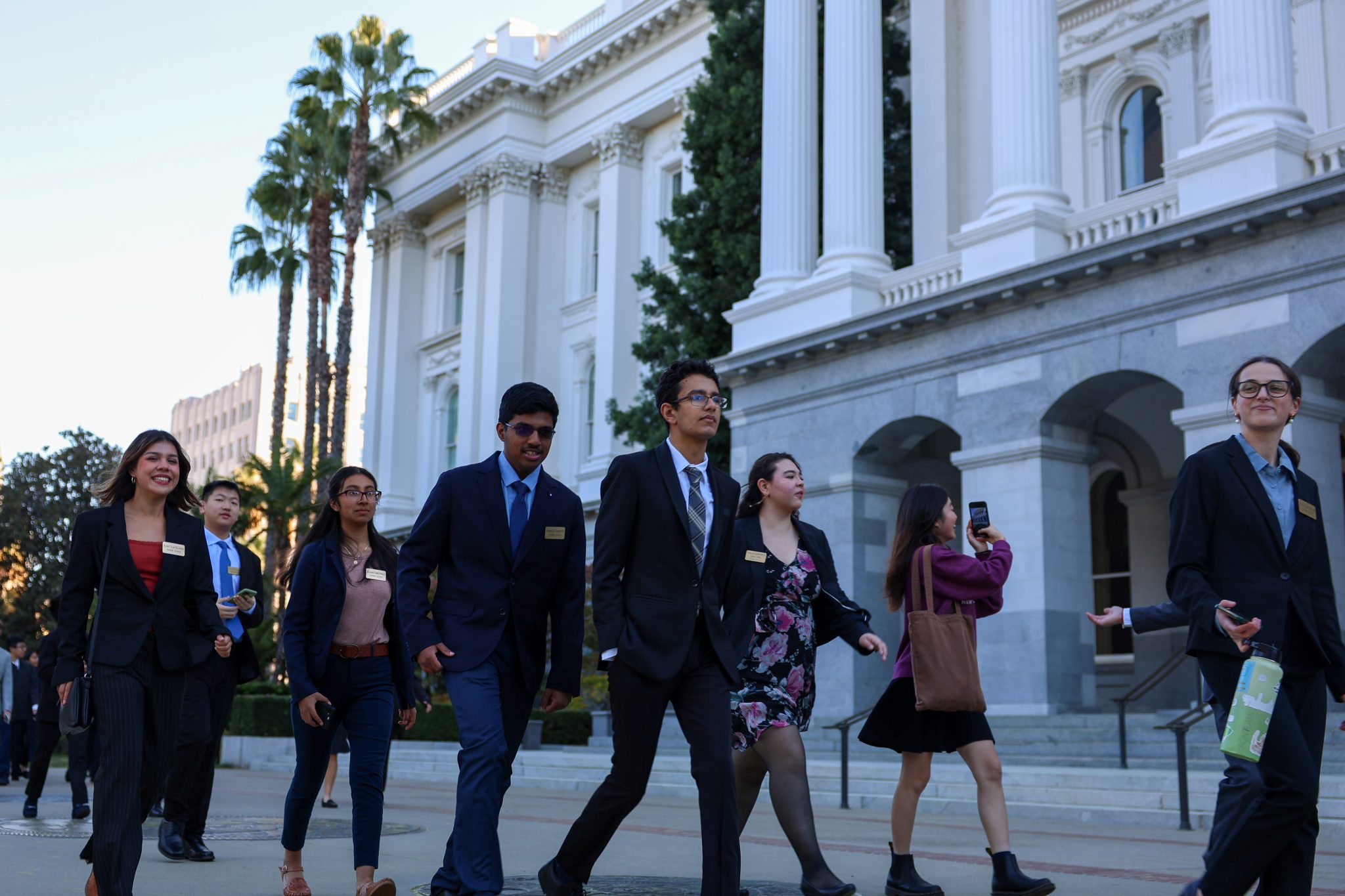
Legislative Policy Committee
CASC’s State Legislative Policy Committee (LPC) is CASC’s central committee for all policy and legislative decisions throughout the year.
They work to research past and present bills, communicate student voices to legislators, and craft new legislation in line with CASC’s legislative priorities (see below). Often working with past SABE and SABLE proposals produced by other CASC students, LPC members refine language, find possible authors in the legislature, and give public testimony in support of their bills.
The current Legislative Policy Committee includes 20 students selected by our Government Affairs Program (GAP) Director.
Our GAP Director serves as a lobbyist in Sacramento, working with legislators and other policymakers to support and draft education-related legislation
Successful CASC Bills
CASC students have contributed to many legislative efforts over the years. The following bills were signed into California law following CASC development or campaigning.
AB-49 (2025). CA Safe Haven Schools Act.
Limits immigration enforcement activities on K-12 campuses, requiring a judicial warrant, subpoena, or court order before allowing immigration officers into nonpublic school areas and prohibiting the sharing of student, staff, or family information with immigration authorities without consent.
Final bill authored by Al Muratsuchi (D-66). Approved by Governor on September 20, 2025.
SB-1445 (2024). Student board members and restorative justice.
Allows student members of district governing boards to make recommendations in restorative justice decisions (such as expulsion hearings).
Final bill authored by Dave Cortese (D-15). Approved by Governor on September 20, 2024.
AB-748 (2022). Mental health resources.
Requires schools serving grades 6-12 to display mental health posters on campus, informing students of mental health tips and available resources.
Final bill authored by Wendy Carrillo (D-51). Approved by Governor on September 19, 2022.
AB-1867 (2022). Sustainable plumbing facilities.
Requires schools to include plans for updating old plumbing infrastructure to CalGreen sustainability standards when planning modernization programs in the same indoor area.
Final bill authored by Alex Lee (D-25). Approved by Governor on September 19, 2022.
AB-367 (2021). Menstrual product access.
Requires all schools to provide free menstrual products to students in grades 6-12 in all-female restrooms, one men’s restroom, and every all-gender restroom by the 2022-2023 school year.
Final bill authored by Cristina Garcia (D-58). Approved by Governor on October 8, 2021.
AB-46 (2021). Youth Empowerment Commission.
Creates California’s first Youth Empowerment Commission – a commission made up of youth throughout California that advises the Governor.
Final bill authored by Luz Rivas (D-43). Approved by Governor on October 8, 2021.
AB-543 (2019). Sexual harassment resources.
Requires schools to display sexual harassment policy and resources on posters in public spaces.
Final bill authored by Christy Smith (D-38). Approved by Governor on October 2, 2019.
AB-261 (2017). Student district board member voting rights.
Grants preferential voting rights to student members serving on their district board.
Final bill authored by Tony Thurmond (D-15). Approved by Governor on September 23, 2017.
SB-468 (2017). Supplying board members with meeting materials.
Requires student board members to receive all meeting materials presented to the board members and requires student members to be invited to staff briefings.
Final bill authored by Connie Leyva (D-20). Approved by Governor on September 25, 2017.
SB-532 (2015). Student district board members.
Mandates district boards to appoint a student board member when petitioned for by the student body.
Final bill authored by Connie Leyva (D-20). Approved by Governor on September 21, 2015.
AB-1204 (2015). Student representation on Instructional Quality Commission.
Encourages the State Board of Education to appoint a student member to the Instructional Quality Commission.
Final bill authored by Ed Chau (D-49). Approved by Governor on September 21, 2015.
SB-1422 (2010). Student feedback surveys.
Permits student governments (grades 9-12) to draft a survey by which students provide feedback to teachers. Survey committees to be composed of students and teachers.
Final bill authored by Gloria Romero (D-24). Approved by Governor on August 25, 2010.
Advocacy Areas
The Legislative Policy Committee regularly compiles a list of priorities to guide CASC’s legislative work. The most recent set of these priorities is available below.
Student Learning Outcomes:
Support adopting curriculum and pedagogy committed to teaching 21st Century skills such as critical thinking, collaboration, and cross-cultural interaction
Grading policy
Support uniform grading policy and practices with equity as a significant consideration throughout their development. They are tier based and conform to schools’ individual needs.
Support the establishment of equal learning experiences and deliverance of content for students regardless of their educational tier or the relative experience of their peers.
Curriculum content
Support adopting curriculums committed to teaching texts & topics related to ethnic studies and black history as well as using materials written by BIPOC authors.
Support adopting curriculums committed to teaching texts & topics related to LGBTQ+ studies and history as well as using materials written by LGBTQ+ authors.
Standardized Testing
Support creating and implementing a Standardized Testing Advisory Council to evaluate the design and administration of the tests.
Support developing tests in different languages representative of test-taking students’ demographics.
Teacher Training and Credentialing
Support periodic training for teachers in technology, socio-emotional learning, cultural competency, racial sensitivity, and developments in education sciences.
Support a diverse staff and max. classroom size of 20 students.
Support updated and culturally responsive credentialing requirements for new teachers.
Support implementing student-to-teacher feedback systems for collaborative, safe, and effective learning environments.
Access to Supplemental Opportunities
Support a system that aids students in receiving adequate supplemental extracurricular activities, access to test-taking or studying opportunities, and activities necessary for college admissions.
Support the suggestion of a student information catalog regarding scholarships, clubs, sports, and by the State Board of Education for highschools across California. Provide students who were unable to participate in sports, clubs, and other activities elemental to the highschool experience with priority access to those activities via the catalog.
College Preparation/Admissions Practices
Support schools offering an accessible resource list of available scholarships and their criteria, deadlines, and other additional important information.
Support schools offering free, accessible seminars and workshops to provide guidance in the college admissions process including scholarships, applications, and essays.
Career Technical Education
Support the proportionate emphasis on career and technical skill-based instruction and inclusion of College and Career Indicators on the LCAP to measure California’s priority of college and career readiness and support the implementation of CTE at schools
Achievement Gap
Support creating a network of support systems outside the classroom including bilingual peer tutors and bilingual counselors for English Language Learners.
Expand school counseling to include at least one Spanish speaking counselor per site.
Support the adoption of teaching models dedicated to personalized learning.
Support high-quality schools in both densely populated and rural areas with support for the unique needs and challenges of rural student populations.
Gender Inclusivity
Support efforts to increase access to all-gender bathrooms, as well as a student’s freedom to choose any bathroom they identify with.
Support non-discriminatory dress codes that allow students to dress in accordance with their gender identity and are not enforced more strictly against transgender and gender non-conforming students.
Learning Disabilities and Special Education
Support a system that caters to certain learning disabilities including increased teacher to student communication and education on instructional practices.
Support the creation of an abundance of materials for both disabled and non-disabled students to better supplement all students’ learning in all education tiers.
Discipline Policies/Restorative Justice
Oppose the current highly-punitive system of discipline implementation/commit to reducing suspensions and expulsions that lead to a student falling further behind.
Support an in depth review of discipline policies and their disproportionate impact on. Latine/hispanic/black students; accompanied, if deemed necessary, by an overhaul of the discipline system that focuses on transformative justice.
Expand discipline policy to protect and provide recourse for students that are victims of harassment based on protected identities/create environments that are safe for students of all identities to engage in.
Support the creation of norms regarding any interpersonal conflict that follow the tenets of restorative justice (avoiding criminalization, centering the voice of the person harmed, peer mediated interaction between the harmed and harm-doer).
Support the creation of norms regarding any disciplinary conflict that follow the tenets of transformative justice (avoiding criminalization, understanding the process by which the harm arised, analyzing the intersections of power dynamics).
School Resource Officers
Support the creation of a committee to interrogate the role/effectiveness of school resource officers as protection on campus with the goal of reducing the practice and re-configuring the funds on a city level to practices that emphasize transformative justice (school counseling, therapy, eg).
Continuum of Care for System-Involved Youth
Support allocation of funds for training and hiring a sufficient volume of mental health professionals.
Improve coordination between social workers, health and human service agencies, justice system, and school districts/county offices of education for comprehensive, wrap-around public-sector services for students where they are.
Technology Divide
Support for uniform access to technology including internet hotspots and devices for both students and faculty.
Support leniency regarding technical difficulties including such things as: video call connectivity issues, failure to submit assignments due to a lack of internet connectivity or insufficient technology, lack of access to study materials
Student Representation
Encourage a student board member position with preferential voting rights in every high school district, a position already guaranteed by previous legislation.
Support student board members having access to all appropriate materials discussed in board meetings, as required by existing legislation.
Support transparency between board members/administrators and students (as appropriate) on issues affecting the school & students’ education.
Support implementation of the inaugural California Youth Empowerment Commission.
Encourage Statewide Youth Commission’s annual report to the Legislature being shared with CASC to be considered at conferences.
Encourage Statewide Youth Commission’s annual report being shared with student board members and leadership classes in all high school districts.
Expand network of student board members and members of Statewide Youth Commission to communicate and share information/resources.
Support lowering the voting age to 16 to give students a voice on matters concerning their education and future.
Support youth commissions/youth members on commissions created by cities, counties, or special districts. Especially if the commission addresses issues that affect youth, e.g. the climate crisis.
Support at-risk/disadvantaged youth being represented as school board members/youth members on commissions, including students of color, low-income students, students with disabilities, students experiencing homelessness, students in foster care, and incarcerated youth.
Civic Education and Voter Registration
Support schools leading voter registration drives for eligible students.
Support initiatives to encourage LEAs to provide information to students about voter registration.
Support schools delivering assemblies/information nights about the importance of voting & what lowering the voting age would mean to students.
Support LEAs implementing civic engagement programs specific to their community, as recommended by the State Seal of Civic Engagement.
Support student input about said civic engagement programs.
Support disadvantaged/at-risk students being represented in said programs.
Environmental Curriculum
- Advocate for an updated climate change and environmental science curriculum within existing frameworks in all elementary, junior high, and high schools.
- Support funding for paperless curriculum in schools, including online textbooks and course materials.
Sustainable Practices and Facilities
- Support legislation and funding that enforces the tri-bin system in all communities.
- Support funding for sustainable school supplies such as recycled paper, stapleless stapler, etc.
- Support legislation and funding for solar power infrastructure for schools, including solar batteries, as a renewable energy resource.
- Support partnering with programs that recycle non-recyclable items, such as TerraCycle or color cycle.
- Support funding for sustainable and plastic-free hygiene products in schools such as recycled paper/bamboo toilet paper and menstrual cups.
- Support funding and legislation for package-free, plant-rich meals to be accessible to all students.
- Support funding and legislation for schools to use recycled water to irrigate greenery and gardens.
- Support funding for accessible refillable water stations and reusable water bottles for all at schools.
- Support funding for motion-sensing faucets, low-flow toilets, Volatile Organic Compounds (VOC) free paint, tile and stone flooring, LED lighting, heat pump water heaters, and hand dryers in California schools.
Climate Advocacy
- Support the California Green New Deal and Green Recovery Plans.
- Support legislation to combat climate change and improve air quality.
- Support youth-centered organizations fighting for climate change initiatives like the Sunrise Movement.
Healthy Meals
- Provide universal access to nutritious, filling breakfasts and lunches, with adequate time allotted in each school day for students to obtain and finish meals.
Mental Health
- Support education providing mental health awareness and early intervention among students, staff, and faculty. In doing so the promotion of resources and supports will be increased.
- Provide forums and create safe spaces to openly speak about mental health. These safe spaces shall provide time in the day to invest in self-care for all students and school personnel.
- Actively encourage avoiding language that perpetuates mental health stigmas. This includes, but is not limited to the words crazy, insane, etc.
- Support equitable access to certified counselors, psychiatrists, and therapists.
- Post and provide awareness of available crisis lines that expand beyond suicide (ex: drug abuse, substance abuse, mental health decline, etc.). Programs of early intervention and post-intervention shall be included.
- Support creating more effective and equitable mental health assessments.
- Support legislation mandating that Local Education Agencies in California serve to adopt policies on the basis of suicide prevention, intervention, and postintervention.
- Support funding for homeless and mental health outreach teams to target at-risk youth.
- Support and promote education on substance misuse and abuse.
School Shootings Crisis Planning/Gun Reform
- Support efforts to work collectively with school sites to maintain transparency of crisis-related action. Establish school safety committees where students can hold direct voice and opinion on ways to provide prevention, intervention, and awareness.
- Support legislation mandating that schools update their Safety Plan annually with all information.
Access to Menstrual Health Resources
- Support the implementation and accessibility of menstrual health resources in either gender restroom as a sign of respect and inclusivity. These facilities shall be safe spaces without stripping individuals of their rights. Access to resources shall be available within restrooms, offices, and possibly among staff.
Sex Education
- Support efforts in consistently updating sexual education curriculum to be more LGBTQ+ inclusive.
- Support initiatives that provide a more inclusive environment to all students where teachers and school personnel respond to annual training regarding lesbian, gay, bisexual, transgender, queer, and questioning pupil (LGBTQ+) through encouraging the use of resources developed by the Department of Education.
- Support more extensive, relevant sex-ed courses and requiring more intensive and frequent consent training.
- Sexual Harassment Policy
- Support legislation requiring that any educational institution in the State of California is mandated to have a written policy on sexual harassment.
Trauma-Informed Care
- Support training that recognizes the signs of mental health decline in students and school personnel. Staff and mandated reporters can comply by reporting concerns of safety, welfare, and wellbeing of a child.
Wellness
- Support curriculum providing knowledge in the physical, emotional, intellectual, interpersonal, environment, occupational, and financial aspects of life.
- Support legislation establishing that no person should be subjected to discrimination under the boundaries of sexual orientation, ethnic group identification, race, national origin, religion, mental or physical disabilities, or any basis.
- Support increased healthcare facilities in schools, such as nurse staffing positions.
- Support programs to provide healthcare to students who may not receive general health and wellness assessments outside of their school environment.
- Support establishing regular general health evaluations/checkups for students.
Student Safety, Health, and Privacy
- Forbid the acts of harassment, intimidation, and bullying. Local Education Agencies shall recommend procedures to be set for investigating and reporting incidents.
- Divest from school resource officers, strengthening schools’ commitment to psychologists, counselors, and trained mental health experts to ensure students feel safe and supported on campus.
- Support later school start times that are consistent with adolescent health and sleep patterns.
- Support School-based social and emotional learning (SEL) programs including engaging classroom materials and specific classroom-management practices.
- Support privacy protections for students in regards to their transcripts, social media, health records, and discipline records. Information should only be disclosed with expressed permission from the student or the student’s parent/guardian.